
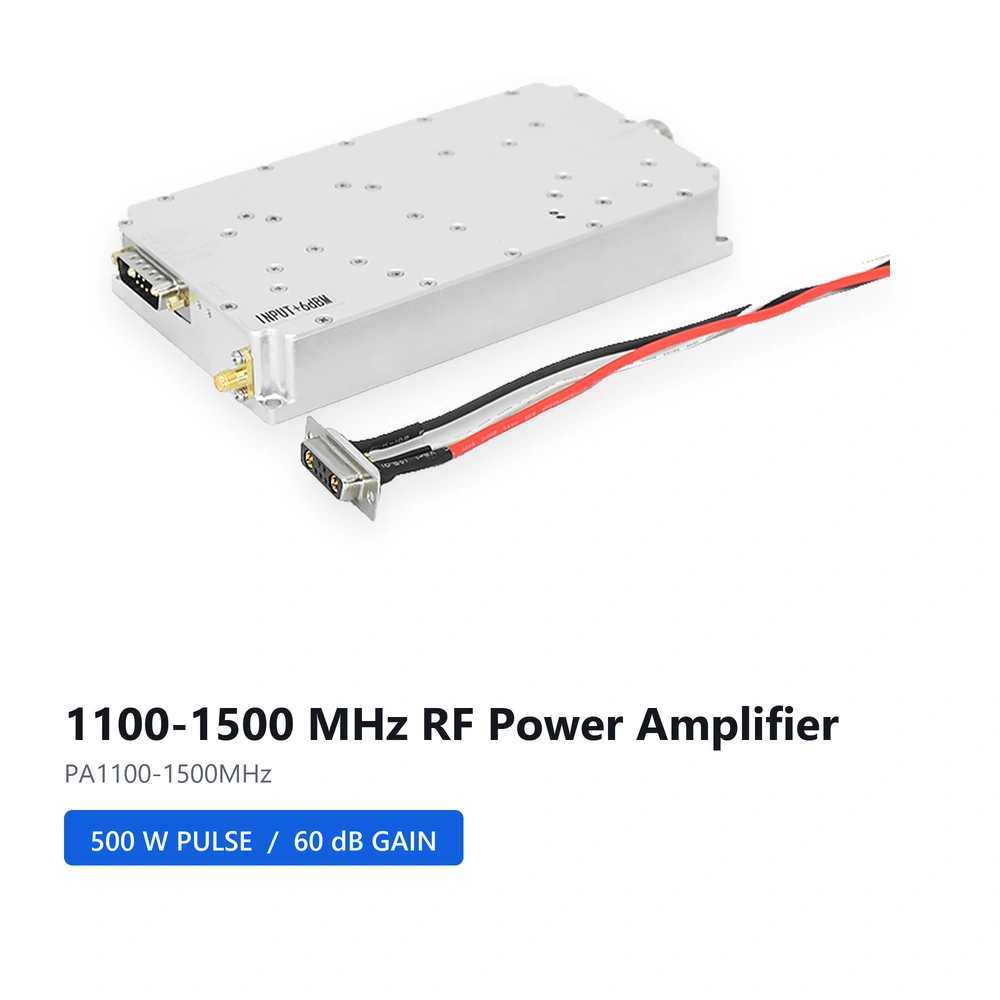
500W 1100-1500MHZ 1.5G Drone Jammer Module anti fpv System RF Power Amplifier Module
500W 1100-1500MHZ 1.5G Drone Jammer Module anti fpv System RF Power Amplifier Module
View productChoosing the right board starts with the link you intend to affect, not the wattage printed on the housing. This selector walks from drone control, video and telemetry links to the frequency classes actually stocked for a jammer module, then narrows the shortlist by output power, DC supply and connector so the uav jammer module you order drops into an existing RF chain without a redesign.
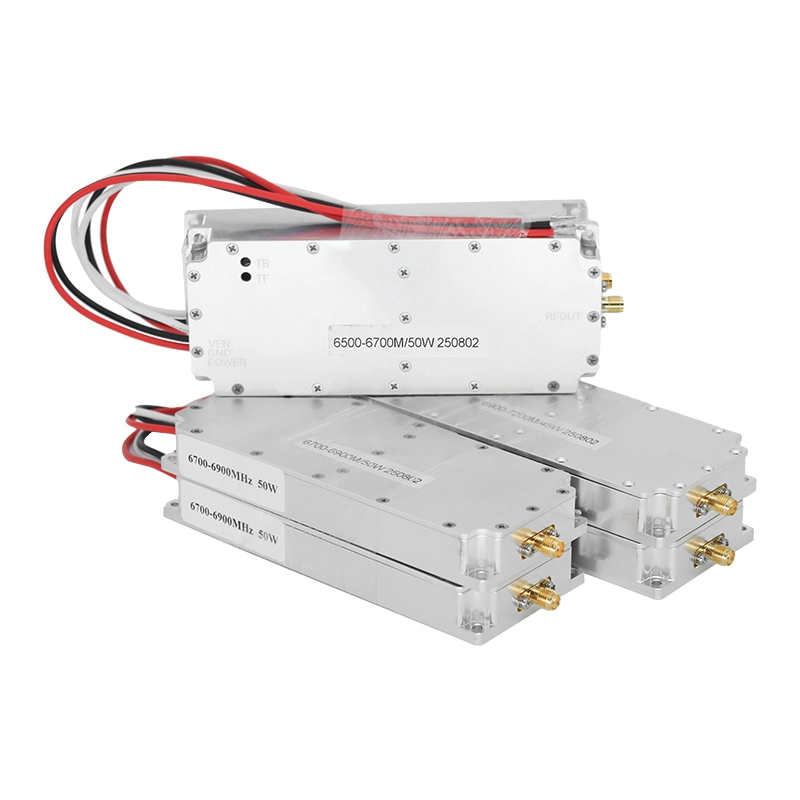
The link fixes the band; power, gain and connectors come afterwards. Use this table to move from a use case to the frequency class you should be quoting.
| Link type | Band class to check | What it changes in the module choice | Next step |
|---|---|---|---|
| Drone control / RC uplink | 1100–1500 MHz class | Band decides the module first. A higher power tier buys headroom against feed loss and cable runs — it does not replace antenna gain. | 500 W 1.5G module |
| FPV video downlink | 6500–6700 MHz class · 8000–12000 MHz class | Video blocks are wide. Match module bandwidth to the block you must cover — the GW-PA50W lists 200/300 MHz of bandwidth. | GW-PA50W / 8–12 GHz |
| Telemetry / data link | 1100–1500 MHz class | Narrow blocks tolerate a single-band module. Check delay if your loop is timing sensitive — the GW-PA50W lists ≤50 ns. | Request a band match |
| GNSS / satellite links | Outside the stocked high-band set | Built to order. Send the start and stop frequency plus the power you need measured at the connector. | Custom — inquire |
Band classes here are application pointers drawn from the stocked catalog, not guaranteed coverage. Confirm the exact block before you commit a design.
Only the 50 W class has a fully published table on this page. The other tiers are either a catalog class or a built-to-order configuration — treat their electrical numbers as items to confirm in writing.
Not listed in the current catalog. If your link budget closes at low power, ask for a 10 W build with your band and connector type and confirm gain and DC draw before design freeze.
GW-PA50W: 47 dBm ±1.5 dBm, gain 47 ±1.0 dB, +24–28 V DC at 3.6 A, SMA ports, 132 × 53 × 17 mm, −40 to +70 °C working range.
A 100 W anti-drone module is listed for 8000–12000 MHz. DC current, gain, connector and cooling requirements are confirmed at the RFQ stage.
A 500 W module is listed for 1100–1500 MHz. Plan the DC feed, heatsinking and connector type with the supplier before you size the enclosure.
Eight things to settle before you send an inquiry. Each one removes a round of questions later.
Put this sentence at the top of your inquiry: “Required band: ____ MHz to ____ MHz, output power at the connector ____, connector type ____, quantity ____.” Everything else — gain, DC current, cooling, packaging — follows from those four blanks.
Every module in this catalog is inquiry-driven: you specify the band, the power tier and the interface, and the configuration is confirmed against your build.
Customization of frequency, power and packaging is available on request through direct contact.
info@greetwin.com +86 151 1226 7605 Contact UsKeep adjacent product options together for a faster catalog comparison.
500W 1100-1500MHZ 1.5G Drone Jammer Module anti fpv System RF Power Amplifier Module
View product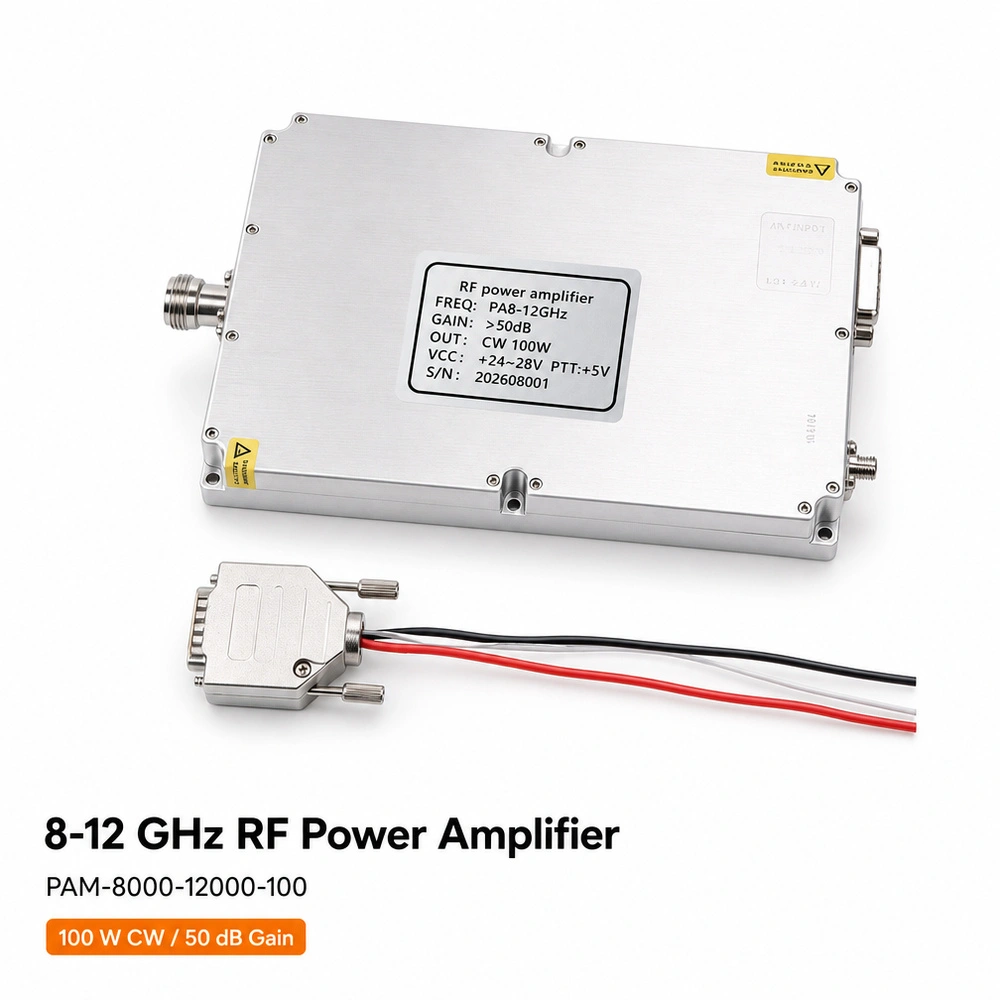
Anti-Drone Module Customized 100W RF Power Amplifier Module Anti-Drone for 8000-12000MHz Wireless Counter FPV
View product
High QualityWiFi Amplifier Signal Booster Amplifier Long Range Extender Wifi Signal Booster
View productstart from the operating block of the link you want to affect, then look for a module that covers it. the stocked classes on this page are 1100–1500 mhz, 6500–6700 mhz and 8000–12000 mhz. anything outside those classes is built to order, so send the exact start and stop frequency rather than a band nickname.
the frequency range tells you where the module operates; bandwidth tells you how wide a block it covers inside that range. the gw-pa50w lists 6500–6700 mhz with a 200/300 mhz bandwidth. specify both numbers in your inquiry so the module is matched to the block you actually need, not just to a nominal band label.
the gw-pa50w uses standardized sma connectors on the input and output, which keeps it compatible with common lab cable assemblies and simplifies maintenance. if your enclosure needs a different interface, state it in the inquiry — the product faq confirms that customization is available through direct contact.
not directly. what the far end receives depends on antenna gain, feed loss and receiver sensitivity as much as on amplifier output. choose a power tier for headroom and thermal margin, then close the link budget on the antenna side. a well-matched, higher-gain antenna can matter more than moving up a power class.
yes. the product page faq states that frequency, power and packaging customization is available through direct contact, and several catalog modules are already listed as customized builds. send the band, the power you need at the connector, your interface and your quantity to get a configuration confirmed.
four numbers carry most of the weight: the start and stop frequency, the output power required at the connector, the connector type, and the quantity. add your available dc rail, the space inside the enclosure and any packaging or labelling requirements. that set is enough for a supplier to come back with a specific configuration and its electrical details rather than a generic catalogue reply.
